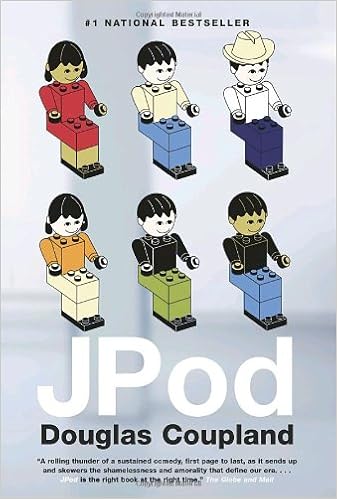
https://www.amazon.ca/JPod-Douglas-Coupland/dp/0679314253
After reading a portion of JPod by Douglas Coupland, I was left both impressed and confused. I can’t decide whether to refer to his works as a novel or a series of lucid realities, but one things for sure, it’s captivating. From disposing the body of your mom’s affair partner to having smuggled humans taking a dump in the kitchen, JPod is sure to be unpredictable. The novel doesn’t really have a set plot line as it is a series of events and everyday life shenanigans, but the setting takes place in a video game company with Ethan Jarlewski as the narrator. Ethan and his coworkers are in a team called “jpod” which is due to a program error that puts new employees with the last name starting with “j” in this specific team. The “pod” portion comes from the fact that they all share the same cubicle pod. From the first page, I could tell that this wasn’t a normal book. (For a more in depth summary you can check out Cumberland Public Libraries)
While reading this novel, there were several moments when I thought to myself, “What leads someone to write something like this”. I couldn’t fathom the idea that an average Joe could produce a puzzle of this caliber, so upon further research, I discovered that the novel is built from his personal experiences. Douglas Coupland’s education is quite broad as he dropped out of McGill sciences to pursue art, which is expressed in the character Mark. Mark’s character is often referred to as a blank slate, but as he expresses his individuality, he claims his greatest change happened after realizing he was studying “to please his parents” (Coupland 40). Douglas Coupland’s mother is a graduate of McGill university and as the author tried to follow his mother’s footsteps, he transferred to Art and Design at Emily Carr College (Hume 2017). A big theme in this novel is the diversity of personality and character throughout the team and this reflects the author’s choice to transfer into art. He describes his 4 years in Emily Carr College as the “best four years of his life” (Hume 2017).
/https://www.thestar.com/content/dam/thestar/entertainment/visualarts/2015/01/29/douglas-coupland-an-author-turned-artist-with-no-turning-back/douglas-coupland.jpg)
https://www.thestar.com/entertainment/visualarts/2015/01/29/douglas-coupland-an-author-turned-artist-with-no-turning-back.html
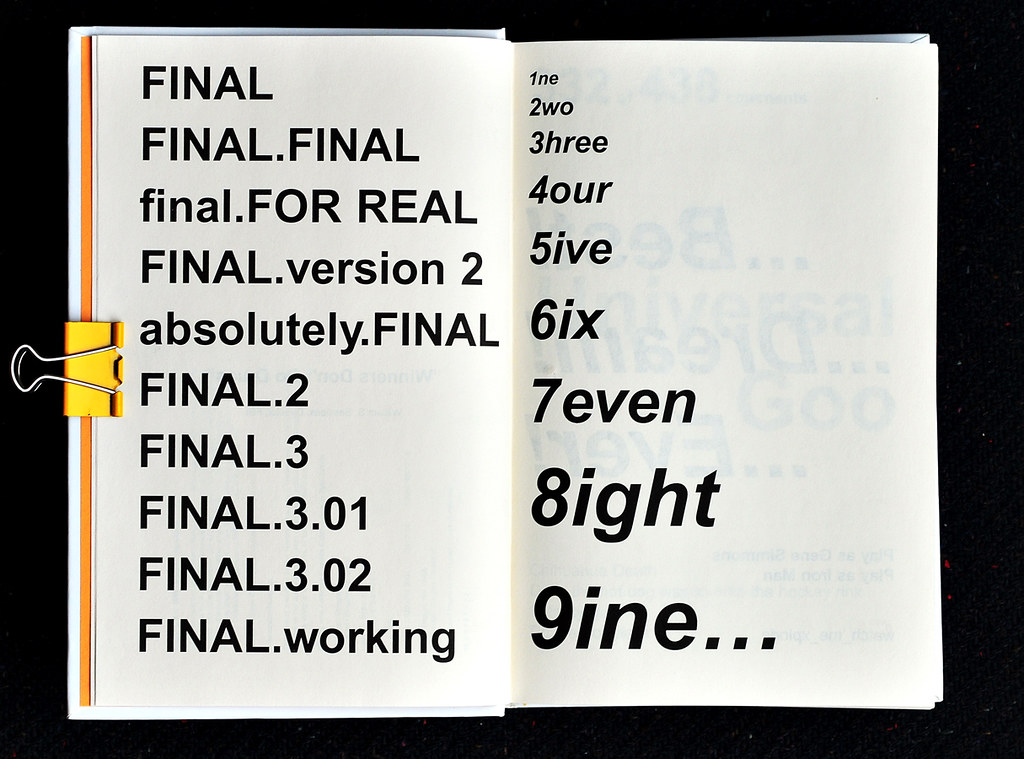
Throughout the novel there are several pages filled with random phrases, ads, emails, and repeated words. As the plot of the novel revolves around computer “geeks”, most of these random pages have hidden meanings. For example, on page 10 of the book, the page is filled with the words “ramen noodles“. This is repeated 364 times and I can assume that this expresses the unhealthy lifestyle of modern youth (Ness 2006). Another page in the novel has the words from a chicken flavored oriental noodle soup package, while some other pages have the title for a CMOS logic and algorithm guide. After 100 pages into the novel, I could tell that this novel reflected the essence of the “geek” culture.

https://www.urbandictionary.com/define.php?term=geek
:no_upscale()/cdn.vox-cdn.com/uploads/chorus_asset/file/8170353/the_matrix_path_of_neo_taking_cover_1680.jpg)
https://www.polygon.com/2017/3/17/14935418/the-matrix-reboot-video-games-enter-path-neo-online
The most enjoyable part about reading this novel is the fact that I could relate to most of the characters. Human trafficking and burying bodies in construction zones are a few of many relatable topics, but the most prominent topics are the computer references. Personally, I have a background in technology as I took several computer classes in Saunders and find tech interesting. I understood most of the relevant references in the novel such as the ASCII codes that spell out “edgy” (Coupland 18). The book is scattered with several internet culture references such as penis enlargement ads and movie characters. It’s clear that these references will not make sense to a wide audience nor will it be funny for them, but to readers with backgrounds in tech and internet, these jokes are surprisingly funny. The fact that the book was published over a decade ago and some of the references are still relevant shows the level of maturity in the target audience hasn’t changed much.
I won’t lie. I expected this course to be hellish, and it is, but the one factor that balances out all the tedious discussion and blog posts is JPod. To me, this book created a whole new reality to leisure reading as I could finally relate something stupid I’ve experienced to a book. The sprinkle of dark humor and the chaotic events really changes reading from a chore to an enjoyable time. I can’t wait to read more!
Works Cited
Coupland, Douglas. JPod. Random House Canada, 2006.
Gray, Brenna Clarke. “View of A Conversation with Douglas Coupland: The Hideous, the Cynical, and the Beautiful: Studies in Canadian Literature / Études En Littérature Canadienne.” View of A Conversation with Douglas Coupland: The Hideous, the Cynical, and the Beautiful | Studies in Canadian Literature / Études En Littérature Canadienne, journals.lib.unb.ca/index.php/SCL/article/view/18926/20720.
Hume, Stephen. “Canada 150: Douglas Coupland Defined a Generation.” Vancouver Sun, 24 Mar. 2017, vancouversun.com/news/local-news/canada-150/canada-150-douglas-coupland-defined-a-generation.
Ness, Patrick. “Review: JPod by Douglas Coupland.” The Guardian, Guardian News and Media, 2 June 2006, http://www.theguardian.com/books/2006/jun/03/fiction.douglascoupland.
 Brandon's Blog